What is Torque in Putting?
Simply speaking, torque is a twisting force that causes rotation. That twisting force is what golfers feel as the face wanting to open or close throughout a putting stroke.
How is Torque Created?
Torque is created when a force does not pass through the axis of rotation, creating a moment arm. A moment arm is the perpendicular distance between the line of force and the axis of rotation. The greater this distance, the greater the torque.
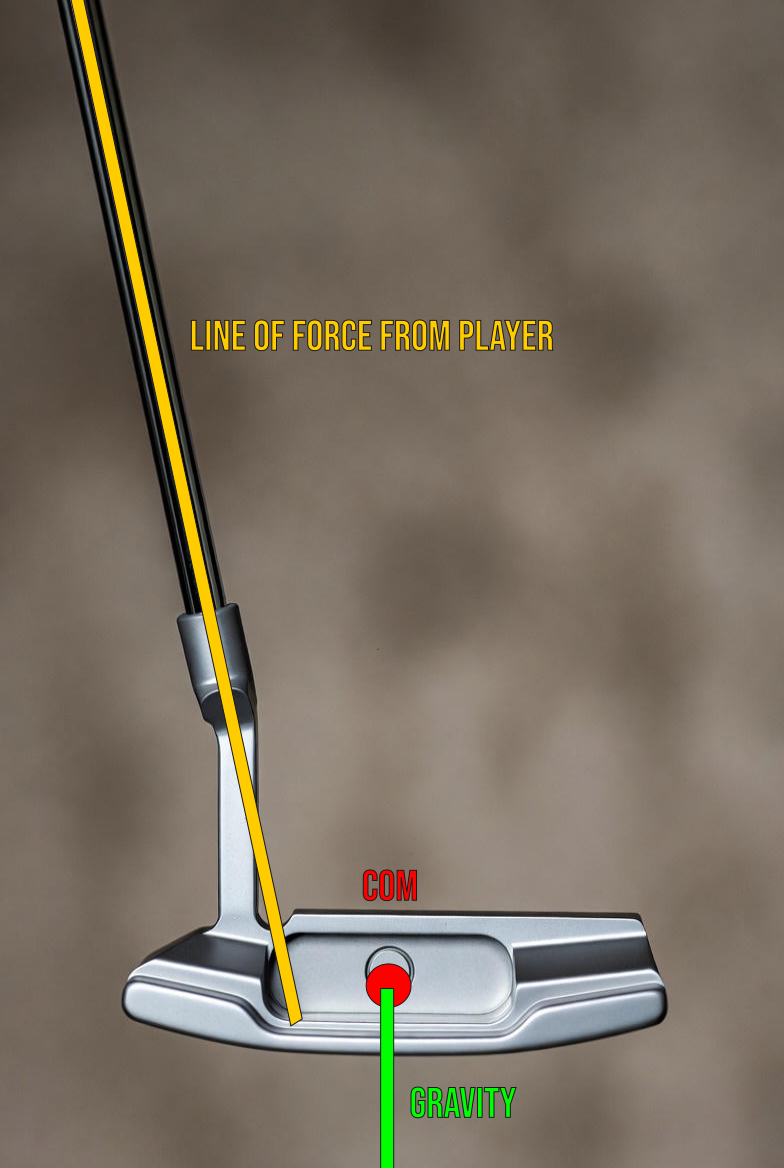
Traditional Putter, notice the line of force does not intersect with the COM. Torque about the COM axis will be occur from the player’s force.
Where is the Axis of Rotation in a Putter?
When no constraints are applied, a putter will naturally rotate about its Center of Mass (COM). You can calculate torque about any axis, but the COM is the special axis where net torque fully governs rotation without coupling to translation — in other words, it is the axis the object “wants” to rotate around.
How Gravity Creates Torque During the Stroke
There are two main sources of torque acting on the putter head during a stroke: Gravity and the player’s applied force. Gravity acts on the putter’s Center of Mass (COM). As we know, the COM is the natural axis of rotation for the putter. So gravity will produce no torque about the COM axis. But, it will produce torque about the shaft axis, the one our hands must hold on to. Conversely, the player’s applied force will produce no torque about the shaft axis, but it will create torque about the COM axis.
These two calculations describe the same single twisting tendency caused by the offset between the shaft axis and the COM. Our hands must constantly counteract this tendency to keep the face square throughout the stroke.
Why Traditional Putters Experience Torque
In a heel-shafted putter, this twisting is unavoidable. Like mentioned above, gravity will create torque about the shaft axis that our hands must fight. When making a putting stroke, the line of force is through the shaft which produces no torque about the shaft axis. Great, except now there is torque about the COM axis, and the putter face is no longer square! Now our hands must fight that torque to keep the face square. This is why traditional putters feel like they are working against the player.
How Zero Torque Putters Work
Zero-torque putters are designed so that the shaft axis passes directly through the putter head’s Center of Mass (COM). This alignment eliminates the moment arm that normally generates torque. Now, both gravity and the player’s applied force act along the same axis: gravity acts through the COM, which is in line with the shaft, and the player applies force along the shaft, which is now aligned with the COM. With no offset between the forces and the rotation axis, the head experiences effectively no torque, keeping the putter face square throughout the stroke.
MOI and Torque: Understanding the Difference
Moment of Inertia (MOI) is a measure of how resistant an object is to rotation around a given axis, or it’s resistance to torque. In simple terms, a higher MOI makes the putter head harder to twist. One way to increase a putter’s MOI is to move weight away from the COM. The farther the weight is from the COM, and the heavier it is, the higher the MOI becomes. MOI is particularly useful in putting because it reduces the twisting caused by off-center strikes. When a ball is hit away from the sweet spot, a high MOI head resists twisting, helping the putt stay on line. MOI can also help resist small twisting forces from the hands, making strokes feel more stable and predictable. It’s important to note that while MOI resists twisting from impacts or hand motion, it does not eliminate torque caused by the shaft being offset from the COM. That’s where zero-torque design comes in.
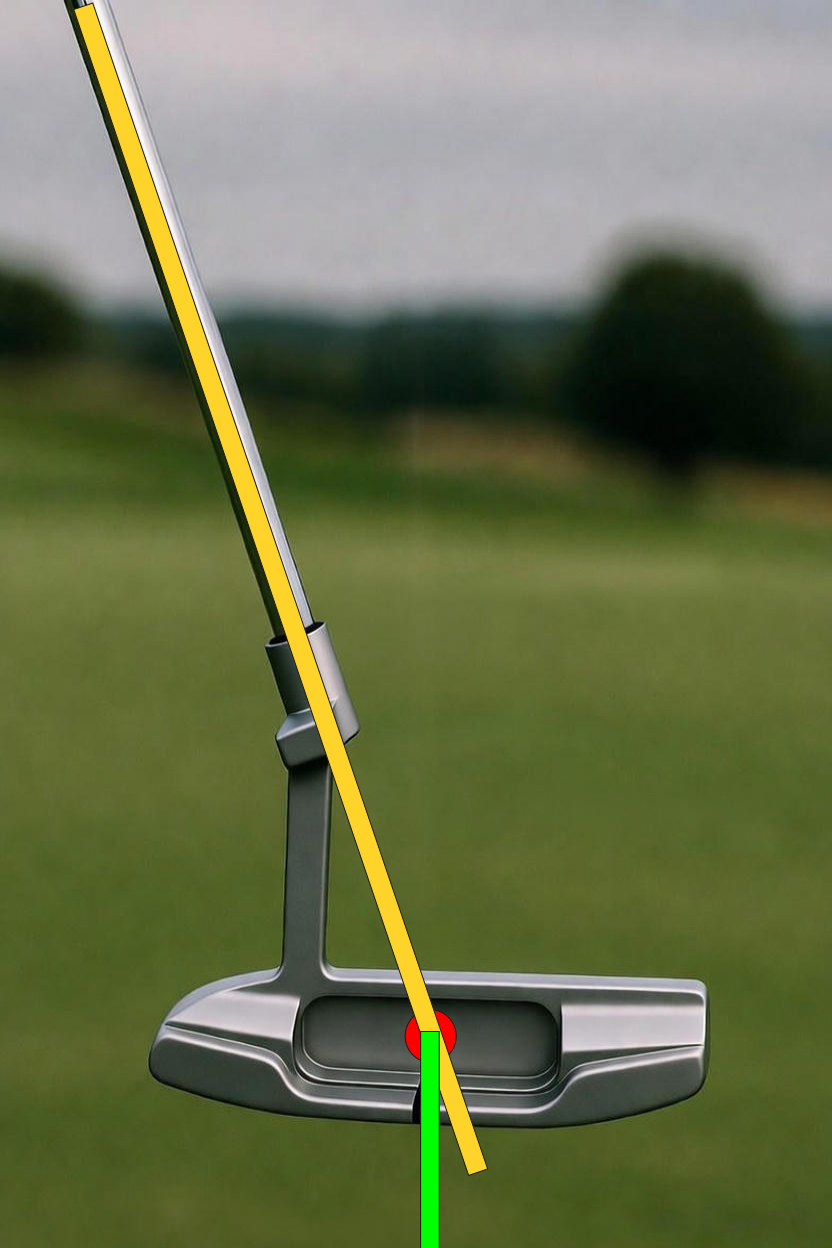
Zero torque putter, notice the line of force intersects the COM. No torque about the shaft or COM axis.
Why Most “Zero Torque” Putters Aren’t Truly Zero Torque
Many putters marketed as “zero torque” are actually toe up designs. While they may appear balanced at address, the COM is still offset from the shaft axis, just in the opposite direction of traditional heel shafted putters. In these designs, the shaft inserts on the toe side of the COM, so if you rest the putter on a surface where it can freely rotate, the toe will naturally point upward. You can test this yourself. A simple indicator of how far the shaft is offset from the COM is how easily the putter twists when rested. This is not to criticize the design — many golfers perform very well with toe-up putters. However, true zero torque putters require the shaft to be aligned precisely with the COM. A putter with true zero torque will maintain whatever position it is placed in when rested on a free rotating surface, without twisting.
Z-Stroke: Nearly Perfect Zero Torque
Z-Stroke putters are engineered to get as close to true zero torque as possible. When tested on a free-rotating surface, Z-Stroke putters twist very little in any position, demonstrating how effectively the shaft is aligned with the COM. On top of that, we are one of the few companies that publish the MOI numbers of our putters. While we strive for perfection, Z-Stroke putters are the closest to true zero torque we have seen.
Try one for yourself at our retailer Good Life Golf Lab