What is Torque in Putting?
Torque is the rotational equivalent of a force. In putting, it’s the feeling of the putter face wanting to open or close during the stroke. Zero torque putters are designed to eliminate this unwanted twisting, helping golfers maintain a square face from address through impact.
How is Torque Created?
Torque is created when a force does not pass through the center of mass (COM), creating a moment arm. A moment arm is the perpendicular distance between the line of force and the COM. The greater this distance, the greater the torque.
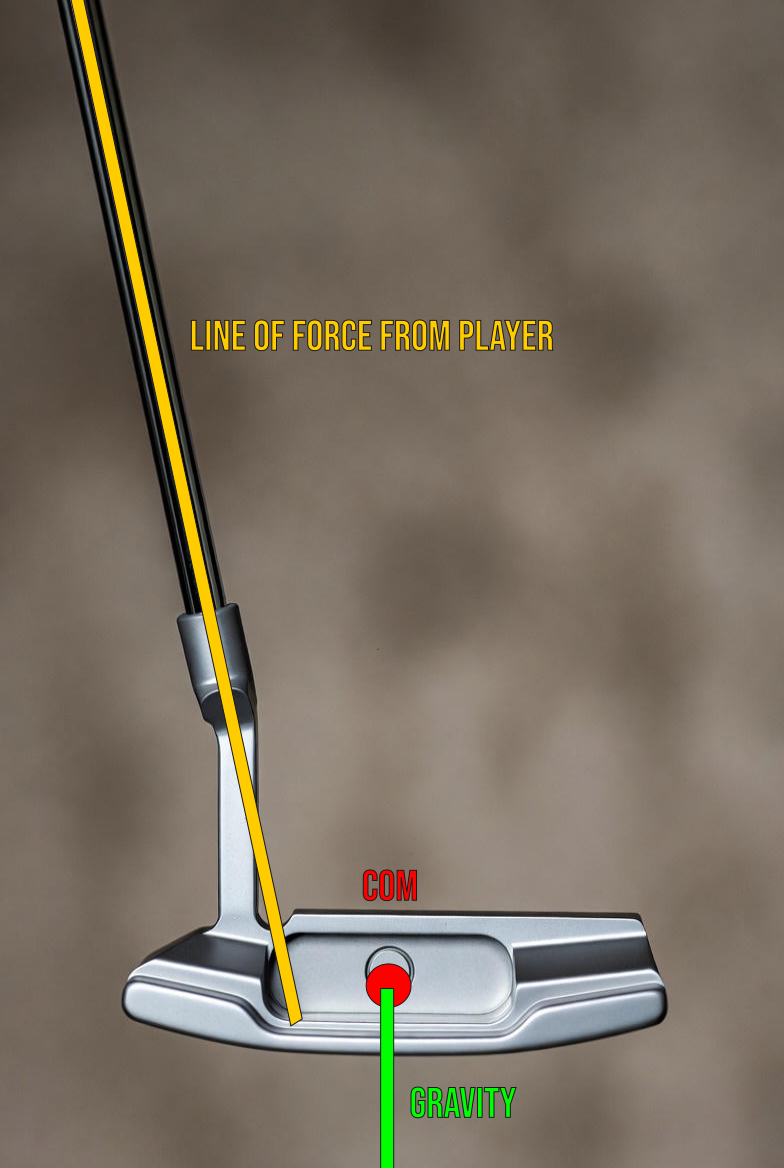
Traditional Putter, notice the line of force does not intersect with the COM. Torque about the COM axis will be occur from the player’s force.
What Axis Does the Putter Rotate Around?
When analyzing an unconstrained putter, rotational motion is described about its Center of Mass (COM). The COM is the special reference point where rotation and translation can be separated. You can calculate torque about any axis, but the COM is the special axis where net torque fully governs rotation without coupling to translation — in other words, it is the axis the object “wants” to rotate around.
Gravity vs. Player Force: Two Sources of Torque
During the stroke, torque is produced in two ways:
Gravity: Acts directly through the COM, so it produces zero torque about the COM. However, if the shaft is offset from the COM, gravity creates torque about the shaft axis, this is what causes toe hang in traditional putters.
Player’s applied force: Transmitted through the shaft axis. This produces zero torque about the shaft axis, but creates torque about the COM when the shaft is not aligned with the COM.
These two effects are really two sides of the same coin: the offset between the shaft axis and the COM. Your hands must constantly counteract these twisting tendencies to keep the face square.
Why Traditional Putters Fight You
In a heel shafted putter, this twisting force is unavoidable. Due to the shaft axis being offset from the COM, traditional putters can experience rotational tendencies from both gravity and the player’s applied force. These torques cause different rotational forces that our hands must fight to keep the face square.
How Zero Torque Putters Work
Zero-torque putters are designed so that the shaft axis passes directly through the putter head’s Center of Mass (COM). This alignment eliminates the moment arm that normally generates torque. Now, both gravity and the player’s applied force act along the same axis: gravity acts through the COM, which is in line with the shaft, and the player applies force along the shaft, which is now aligned with the COM. With the shaft axis aligned with the COM, the lever arm between the applied force and COM is eliminated.
MOI and Torque: Understanding the Difference
Moment of Inertia (MOI) is a measure of how resistant an object is to rotation, or it’s resistance to the effects of torque. In simple terms, a higher MOI makes the putter head harder to twist. You can increase MOI by moving weight away from the putter’s COM, or by making the putter heavier (or a combination of the two). MOI is particularly useful in putting because it reduces the twisting caused by off-center strikes. When a ball is hit away from the sweet spot, the force misses the COM and produces a torque that causes the putter face to rotate. A high MOI head resists twisting, helping the putter face stay square and the putt stay on line. MOI can also help resist small twisting forces from the hands, making strokes feel more stable and predictable. It’s important to note that while MOI resists twisting from impacts or hand motion, it does not eliminate torque caused by the shaft being offset from the COM. That’s where the zero torque putter design comes in.
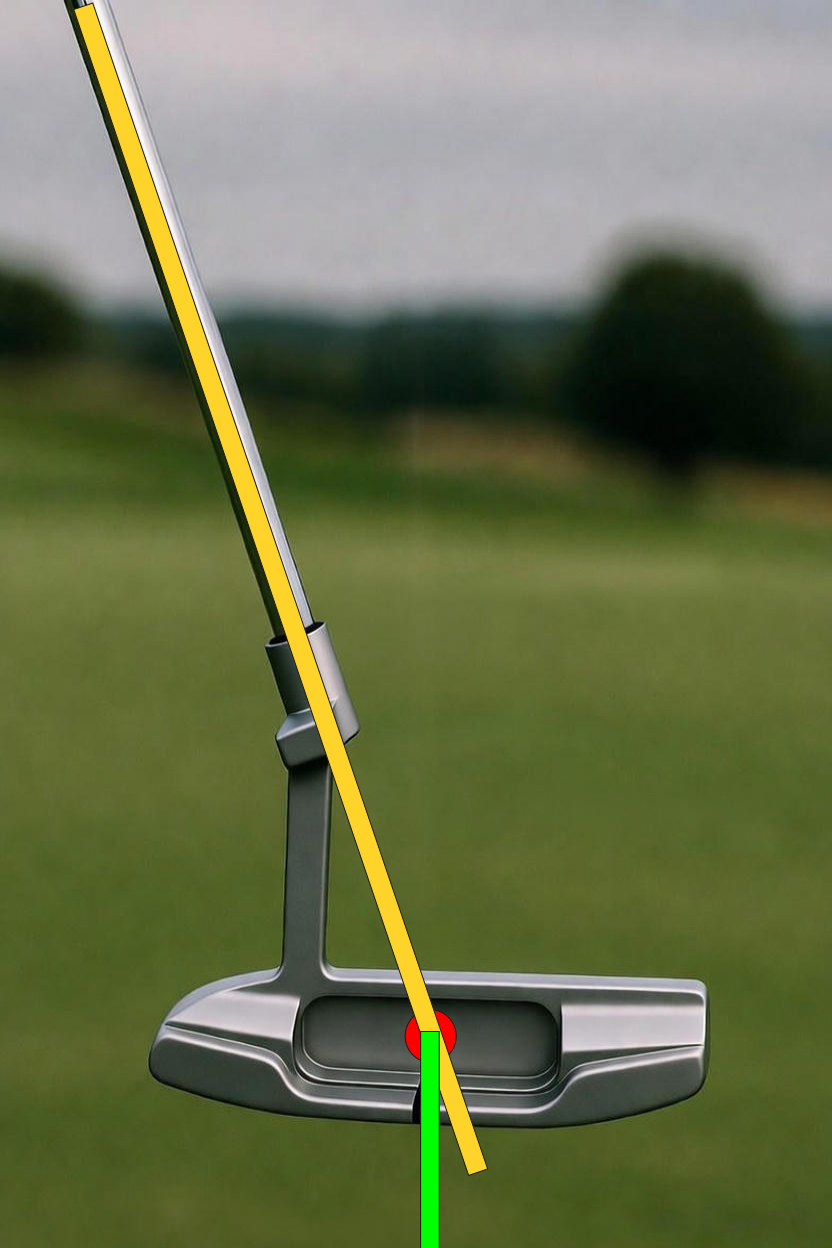
Zero torque putter, notice the line of force intersects the COM. No torque about the shaft or COM axis.
Why Most “Zero Torque” Putters Aren’t Truly Zero Torque
Some putters marketed as “zero torque” use toe up balancing principles. While some toe up designs reduce torque compared to traditional toe hang putters, the shaft axis may still be offset from the COM, just in the opposite direction of traditional heel shafted putters. If you rest a toe up putter on a surface where it can freely rotate, the toe will naturally point upward. You can test this yourself. A simple indicator of how far the shaft is offset from the COM is how easily the putter twists when rested. This is not to criticize the design — many golfers perform very well with toe up putters. However, true zero torque putters require the shaft to be aligned precisely with the COM. A putter with true zero torque will maintain whatever position it is placed in when rested on a free rotating surface, without twisting.
Z-Stroke: Designed for True Zero Torque
Z-Stroke putters are engineered to get as close to true zero torque as possible. When tested on a free-rotating surface, Z-Stroke putters twist very little in any position, demonstrating how effectively the shaft is aligned with the COM. On top of that, we publish the MOI numbers for every putter we sell, so you can compare the specs yourself.
Try one for yourself at our retailer Good Life Golf Lab